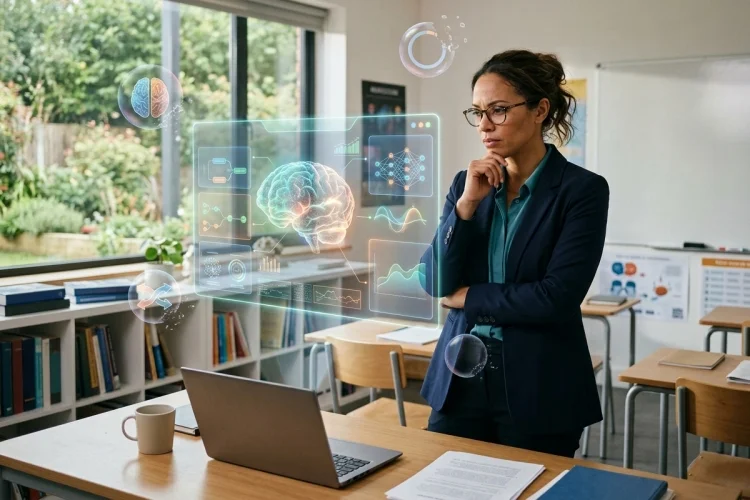
Put the word “neuro” in front of an educational product and it can immediately sound scientific. Add artificial intelligence, personalization, and adaptive learning, and the technology may seem even more convincing.
That is exactly why teachers need to separate useful educational technology from exaggerated claims. Neurosoft Education is currently presented publicly as an AI tutor aimed at neuroscience students.
Its product listing describes features such as turning textbooks and notes into personalized drills, identifying areas of difficulty, generating adaptive questions, and supporting voice-based study.
Those features can certainly be useful. However, they should not be confused with proof that every activity generated by the platform is backed directly by neuroscience.
The wider education field has struggled with neuromyths for years. These are misconceptions created when real findings about the brain are misunderstood, oversimplified, or stretched beyond the available evidence.
Here are some common Neurosoft Education myths teachers should avoid when evaluating AI-powered and neuroscience-related learning tools.
Myth 1: Neurosoft Education Is the Same as Educational Neuroscience
The first misconception is mostly about terminology.
Neurosoft Education is a particular AI tutoring product. Educational neuroscience, on the other hand, is a research field that studies relationships between the brain, cognition, development, and learning.
These are not interchangeable concepts.
The Neurosoft Education product listing focuses on personalized practice for neuroscience students. Educational neuroscience involves researchers from areas such as neuroscience, psychology, cognitive science, and education trying to understand learning more broadly.
Teachers should therefore avoid assuming that using an app containing “neuro” in its name automatically means they are practicing educational neuroscience.
What Teachers Should Do Instead
Evaluate the actual learning activity.
Ask whether students are recalling information, solving meaningful problems, receiving useful feedback, revisiting difficult material, and applying knowledge. Those questions are usually more valuable than the branding attached to the software.
Myth 2: A Neuroscience Label Means the Method Is Scientifically Proven
Scientific language can make educational technology sound more trustworthy than it actually is.
Words such as brain-based, neural, cognitive, and neuroscience-powered may describe something meaningful, but they are not evidence by themselves.
Research has repeatedly warned that neuroscience findings can become distorted when they move from laboratories into popular educational practice.
Howard-Jones, for example, described how neuromyths have become established among teachers and can contribute to ineffective educational approaches.
This distinction is important when looking at Neurosoft Education.
Its public listing describes features such as adaptive quizzes and personalized drills. Those are product features, not automatically evidence that the specific platform improves grades, memory, or long-term learning.
In the sources reviewed for this article, I did not find independent peer-reviewed research specifically demonstrating the effectiveness of the Neurosoft Education/Tutor AI product itself.
Teachers should therefore separate what a product promises to do from what research has shown it can achieve.
Myth 3: Every Student Has One Fixed Learning Style
This is probably one of the best-known educational neuromyths.
The idea sounds reasonable: some students are “visual learners,” others are “auditory learners,” and others learn best through movement. Teachers are then encouraged to match instruction to each student’s supposed style.
The problem is not that people lack preferences. Someone may genuinely enjoy diagrams more than lectures.
The unsupported leap is assuming that matching teaching to a preferred visual, auditory, or kinesthetic style reliably improves learning outcomes.
Research reviews on neuromyths have repeatedly identified the learning-styles belief as widespread among educators.
A 2025 study, for example, found very high endorsement of the claim that learners perform better when teaching matches their preferred learning style among the teachers surveyed.
Software should therefore not place students permanently into categories such as “visual brain” or “auditory brain.”
Good digital learning is more flexible.
A geography lesson may genuinely benefit from maps, while pronunciation needs sound and geometry may benefit from diagrams. The best format depends heavily on what is being learned, not simply on a personality-style label.
Myth 4: Students Are Either Left-Brained or Right-Brained
Another persistent myth divides students into two groups.
“Left-brained” learners are often described as logical and analytical, while “right-brained” learners are presented as creative and intuitive.
Real brain function is much more interconnected.
Different functions can involve specialized networks and some processes show hemispheric differences, but this does not justify classifying entire learners as left-brained or right-brained.
Research examining neuromyths among educators has consistently identified left-brain/right-brain learning as one of the common misconceptions found across countries.
This matters for educational software because algorithms can make categories feel unusually authoritative.
If software tells a student, “You are a right-brain learner, so you need creative lessons,” that label may unnecessarily restrict how the student sees their own abilities.
Teachers should encourage flexibility instead.
A learner can develop mathematical reasoning, creativity, language skills, memory strategies, and problem-solving ability without being assigned to one side of the brain.
Myth 5: Adaptive AI Always Knows What a Student Needs
Adaptive technology is one of the most attractive ideas in modern educational software.
Neurosoft Education’s listing says its AI identifies what learners do not understand and adjusts questioning around those areas. In principle, this can make practice more targeted.
But adaptive software only sees the information available to it.
Imagine that a student repeatedly answers neuroscience questions incorrectly. The algorithm might conclude that the learner lacks knowledge and provide easier exercises.
But perhaps the problem is different.
The student may misunderstand the question’s wording, be learning in a second language, feel tired, have missed an earlier lesson, or simply be clicking quickly because class is about to end.
Data shows behavior. It does not automatically explain why the behavior happened.
Teachers bring context that algorithms often lack.
UNESCO’s guidance for teachers emphasizes human agency, critical thinking, ethical judgment, and responsible use when AI is introduced into education.
Adaptive AI is therefore best treated as a source of additional information rather than an unquestionable decision-maker.
Myth 6: More Practice Automatically Means More Learning
AI tutors can generate enormous numbers of questions.
That sounds useful, but quantity is not the same as quality.
A student might complete 100 easy multiple-choice questions and feel extremely productive while barely strengthening deeper understanding.
Another student might answer only ten difficult questions but spend time explaining reasoning, correcting mistakes, and connecting new information with previous knowledge.
The second session may involve much richer learning.
Teachers should therefore look beyond dashboards showing completed activities, streaks, question totals, or time spent in an application.
Ask what students are actually doing.
Are they retrieving information from memory? Are questions becoming more challenging? Do learners receive explanations after mistakes? Can they apply the concept in a new context?
Software can make practice easier to organize, but it cannot guarantee that every repetition produces meaningful learning.
Myth 7: AI Tutors Can Eventually Replace Teachers
Perhaps the biggest Neurosoft Education myth to avoid is the idea that increasingly intelligent tutoring software will make teachers unnecessary.
AI can perform tasks that are genuinely helpful.
It can generate practice questions, simplify explanations, organize study activities, provide quick responses, and potentially adapt exercises according to student performance.
But teaching involves much more than delivering information.
Teachers interpret confusion, notice emotional changes, manage classroom relationships, motivate reluctant learners, connect lessons with real situations, choose appropriate challenges, and make judgments based on context.
UNESCO’s current approach to AI in education emphasizes a human-centered model in which technology supports learning while educators retain an essential role in guiding its responsible use.
A useful way to think about Neurosoft Education is therefore as a possible learning assistant, not an autonomous teacher.
A student might use the software to practice neuroscience terminology after class. The teacher can then use classroom time for discussion, misconceptions, demonstrations, case studies, and deeper reasoning.
Technology handles some repetition. Humans provide meaning and judgment.
The most important lesson behind common Neurosoft Education myths is simple: impressive technology should still be evaluated critically.
Neurosoft Education offers AI-based features such as personalized drills and adaptive practice, but teachers should not confuse those features with automatic scientific validation.
Avoid fixed learning-style labels, left-brain/right-brain classifications, exaggerated “brain-based” claims, blind trust in adaptive algorithms, and the assumption that more digital activity always produces better learning.
Research shows that neuromyths remain surprisingly persistent in education, which makes scientific literacy increasingly important for teachers.
The best approach is to combine useful technology with credible evidence and professional judgment.
Before adopting any neuroscience-inspired educational tool, ask what evidence supports it, what students are actually doing with it, and whether it genuinely improves the learning experience.