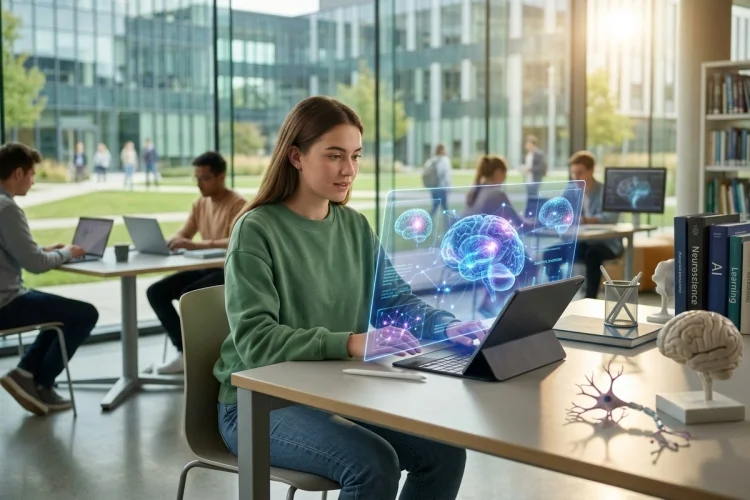
Studying neuroscience can feel overwhelming. There are brain regions to remember, biological processes to understand, technical vocabulary to master, and research concepts that often seem complicated at first.
This is where digital learning tools such as Neurosoft Education aim to make studying more manageable. Neurosoft Education, currently presented publicly as Neurosoft Education/Tutor AI, is an AI-powered study tool designed primarily for neuroscience students.
Its product description focuses on turning learning materials into personalized practice, identifying areas where students need more work, and providing adaptive questions that respond to their progress.
However, there is an important distinction to understand. Neurosoft Education should not automatically be confused with neuroeducation, a broader academic field that connects neuroscience, psychology, cognitive science, and education.
So, what is Neurosoft Education, how does it work, and where might it fit into modern learning? Let’s break it down in simple terms.
What Is Neurosoft Education?
In its current public form, Neurosoft Education refers to an AI tutoring product aimed at learners studying neuroscience. The service is presented by NeuroSoft Innovations and focuses on personalized study activities rather than functioning as a school, university, or academic discipline.
The basic idea is simple: instead of reading the same notes repeatedly, students can use an AI tutor to turn learning material into active questions and practice exercises.
For example, imagine you are studying the hippocampus, working memory, synaptic plasticity, and neurotransmitters for an upcoming exam.
Rather than simply rereading several chapters, an AI tutor could create questions based on those subjects and concentrate additional practice on concepts you struggle to explain correctly.
That approach reflects a wider trend toward AI-assisted and personalized learning. UNESCO notes that artificial intelligence can support applications such as personalized tutoring, although responsible use and human oversight remain important.
How Does Neurosoft Education Work?
According to its public product description, Neurosoft Education focuses on three main ideas: customized practice, adaptive learning, and flexible study access.
1. Turning Study Materials Into Practice
One of the advertised features is the ability to transform textbooks or notes into personalized drills and exam-style questions.
This can be useful because passive reading is not always enough to reveal what you actually understand. A paragraph may look familiar when you read it, but explaining the same idea without looking at the page can be much harder.
Suppose a student uploads notes about action potentials. Instead of reading those notes five times, the learner might receive questions asking what causes depolarization, how sodium and potassium ions are involved, and what happens during the refractory period.
The result is a more interactive study process.
2. Adapting to Weak Areas
Neurosoft Education also describes an adaptive approach in which the system identifies areas a learner has not mastered and provides additional questions around those topics.
In practical terms, two students could therefore have different study experiences even when preparing for the same subject.
One student might need extra work on neuroanatomy, while another understands anatomy well but struggles with experimental methods.
Adaptive systems can potentially direct more attention toward those individual gaps instead of giving every learner exactly the same sequence of activities.
Neurosoft Education vs. Neuroeducation
The names sound similar, but Neurosoft Education and neuroeducation are not the same thing.
Neuroeducation, also called educational neuroscience in many contexts, is an interdisciplinary field connecting neuroscience with areas such as psychology, cognitive science, learning science, and educational practice.
Researchers investigate questions involving memory, attention, brain development, emotion, learning difficulties, and other processes that may influence education.
Neurosoft Education, on the other hand, is a particular AI learning tool.
Think of it this way: neuroeducation is a research field, while Neurosoft Education is a digital product designed to assist learning.
There is another possible source of confusion. Neurosoft Academy, operated by Neurosoft LLC, is also a separate platform.
It provides training materials, webinars, courses, and resources primarily related to the company’s neurophysiology and medical equipment. It should not be assumed to be the same service as the Neurosoft Education/Tutor AI listing.
Why AI Tutoring Can Be Useful for Learning
The biggest attraction of an AI tutor is not that it magically makes difficult material easy. Its value comes from making practice more accessible and responsive.
Traditional studying is often fairly static. Students read a chapter, highlight important sentences, take notes, and perhaps answer a fixed set of questions at the end.
AI tools can make the experience more interactive. A learner can ask follow-up questions, request simpler explanations, generate additional exercises, or revisit a topic from another angle.
UNESCO has highlighted personalized learning and tutoring among the potential educational applications of AI while also stressing that AI should support human-centered education rather than replace human judgment.
For a neuroscience student, this could mean asking an AI tutor to explain the difference between sympathetic and parasympathetic pathways, then requesting five questions to test that knowledge immediately afterward.
How Neurosoft Education May Support Neuroscience Students
Neuroscience involves several overlapping disciplines, including biology, psychology, chemistry, medicine, and cognitive science. That combination can create a large amount of terminology and interconnected information.
An adaptive tutor may help break that information into manageable learning sessions.
A student studying memory, for instance, could start with basic definitions before moving into hippocampal function, memory consolidation, long-term potentiation, and neurological disorders affecting memory.
The same approach could be used for neuroanatomy. Instead of attempting to memorize dozens of structures at once, learners could work through smaller groups and repeatedly practice structures they confuse.
The Neurosoft Education listing also promotes voice-based study as a way of accessing learning activities in different situations.
However, these features describe how the product is intended to work. They should not be interpreted as proof that this specific platform produces better academic outcomes.
I did not find independent peer-reviewed research evaluating the effectiveness of the specific Neurosoft Education/Tutor AI product in the sources reviewed for this guide.
What Are the Limitations of Neurosoft Education?
AI tutors can be helpful, but they should not become the only source a student trusts.
Generative AI systems can sometimes produce incorrect, incomplete, outdated, or overly confident explanations. UNESCO therefore recommends a human-centered approach to generative AI in education, including attention to accuracy, privacy, ethics, and appropriate human oversight.
This is especially important in neuroscience and health-related subjects, where small factual differences can matter.
Students should compare important explanations with textbooks, lecture materials, peer-reviewed research, and instructor guidance.
There is also a wider lesson from educational neuroscience. Scientific-sounding claims about the brain are not automatically reliable. Research has documented the persistence of neuromyths, or popular misconceptions about brain function and learning.
In other words, seeing words such as “brain,” “neural,” or “neuroscience” in a learning product does not automatically prove that its teaching methods are scientifically validated.
How to Use Neurosoft Education More Effectively
The best approach is to treat an AI tutor as a study partner rather than an unquestionable expert.
Start with trustworthy course materials. After reading a chapter or attending a lecture, use the tutor to create practice questions about what you have learned.
Instead of immediately asking for an answer when something feels difficult, try explaining the concept yourself first. Then use AI feedback to identify missing details.
You can also ask for different levels of difficulty. For example, begin with ten basic questions about neuron structure, move to intermediate questions about electrical signaling, and finish with scenario-based questions requiring you to apply the concepts.
Most importantly, verify complicated scientific explanations. AI-generated practice works best when it complements reliable educational resources rather than replacing them.
Is Neurosoft Education the Future of Learning?
Neurosoft Education represents one small part of a much larger movement toward AI-supported education.
AI systems are increasingly being explored for tutoring, feedback, personalized practice, content generation, and educational support.
At the same time, major educational organizations continue to emphasize the importance of teachers, critical thinking, human agency, privacy, and responsible implementation.
The future will therefore probably not be a choice between human teaching and artificial intelligence.
A more realistic model is one where instructors provide expertise, context, encouragement, and judgment while AI tools help students practice, review, and explore difficult material independently.
For complex subjects such as neuroscience, that combination could be especially useful.
So, what is Neurosoft Education? In its current public form, it is an AI-powered tutoring tool designed to help neuroscience students study through personalized questions, adaptive practice, and flexible learning activities.
It is different from neuroeducation, which is the broader scientific field exploring connections between the brain, learning, psychology, and education.
Its potential value lies in making study sessions more active and personalized. However, AI-generated explanations should still be checked against reliable academic sources, particularly when studying scientific or medical topics.
If you are curious about AI-assisted learning, try using tools like Neurosoft Education alongside your textbooks, lectures, and trusted research. Experiment with practice questions, test your understanding, and use technology to support-not replace-careful learning.